
Can a recording tell you how loud the original sound was?
A clip peaks at −3 dBFS. Someone describes it as proof that a machine was dangerously loud. The number does describe something measurable in the file, but it does not give the sound pressure beside the machine. Without a suitable calibration and a known recording chain, there is no dependable conversion from that peak to environmental decibels.
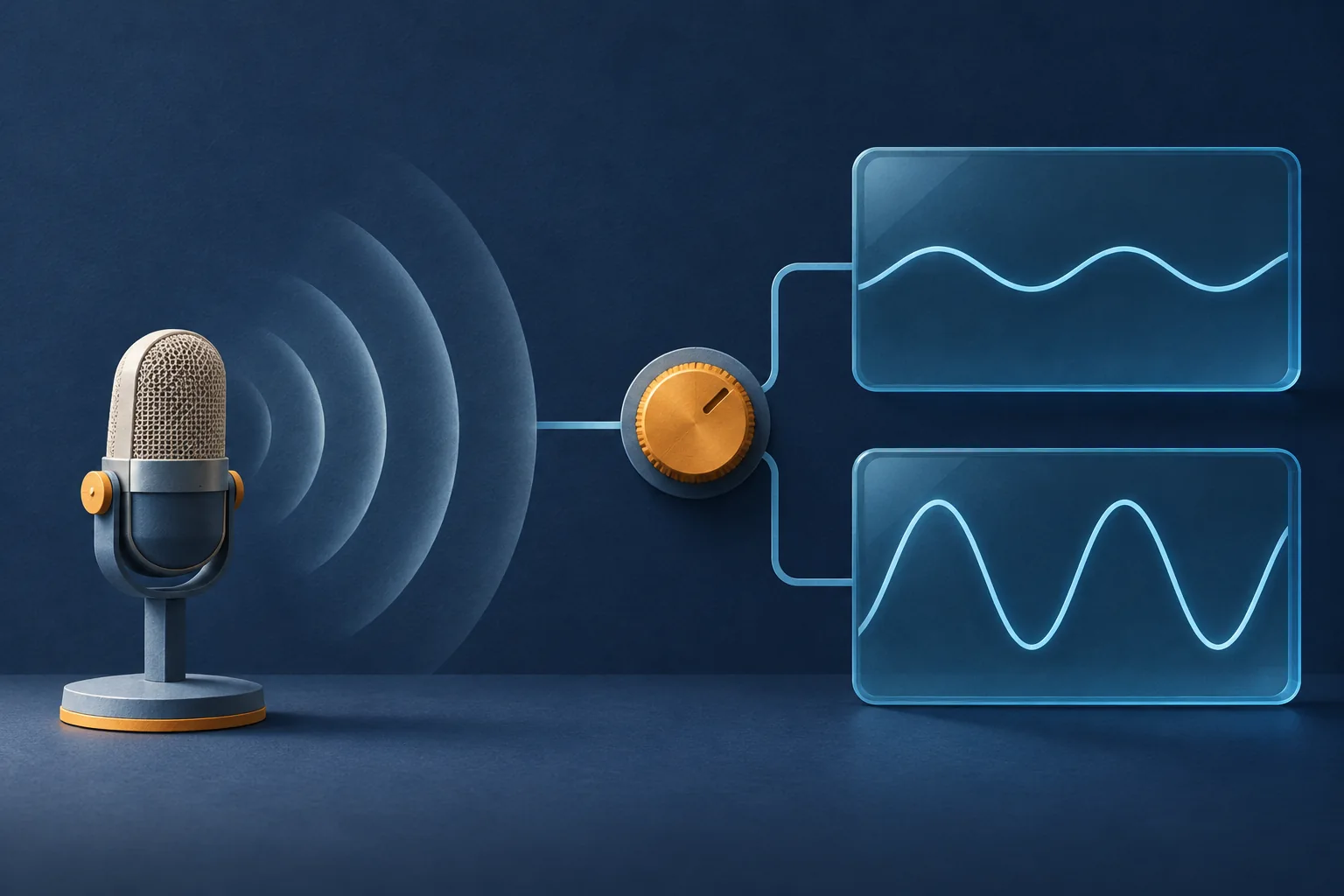
Ask what the decibel value is relative to
For the sample-peak measurement used here, dBFS compares the largest digital sample with full scale. A peak near zero has little digital headroom. Sound pressure level, or dB SPL, instead compares acoustic pressure with a reference pressure; in air, that reference is 20 micropascals. NI’s microphone measurement guide explains the physical reference and why microphone sensitivity and the measurement environment matter.
The two values have different reference points. A recording gain control can change the samples without changing the event that already happened. Playback volume adds another independent adjustment. Turning your headphones down does not revise the file’s sample peak, and a large peak does not tell you how far the microphone stood from the source.
Keep peak amplitude separate from average level and perceived loudness, too. A brief click can set the maximum for an otherwise quiet file. Always name the measurement and the interval instead of writing only “the audio is −3 dB.”
A one-second experiment with no real sound source
This is a synthetic numerical exercise, not a field recording. We generated a one-second, 1,000 Hz sine wave at 48,000 samples per second, stored as mono 16-bit PCM. Its intended amplitude was 0.1 of positive full scale. We then multiplied the stored samples by five and saved a second WAV. No microphone, room or person was involved.
| File | Largest absolute sample | Sample peak, rounded |
|---|---|---|
| Original teaching signal | 3,277 | −20.00 dBFS |
| Copy with fivefold gain | 16,385 | −6.02 dBFS |
For this exercise, the calculation is 20 × log10(peak / 32767). The gain difference is 20 × log10(5), about 13.98 dB. Small rounding differences come from storing whole-number samples. Both files contain 48,000 samples and the same one-second pattern. Our local file check confirmed those counts and peaks; it did not measure acoustic pressure.
To repeat the idea in an audio editor, generate a low-amplitude tone, preserve it, and amplify a copy by about 13.98 dB without clipping. Audacity’s Amplify reference describes the gain and new-peak controls. That is a suggested exercise, not a claim that we tested the current Audacity interface. The result demonstrates a change in the file’s level; it supplies no SPL value for either version.
Check the chain before comparing two clips
Imagine two invented recordings of the same workshop: one phone uses automatic gain, while another recorder uses a fixed input setting. If the first file has a higher peak, the machine need not have been louder during that recording. Position, microphone response and processing remain unresolved. Even matching device models would not establish matching settings.
Use a small evidence card for each file:
- Material: source URL, retrieval time, original filename and preserved-file hash.
- Measurement: channel, exact interval, sample-peak method and result.
- Acquisition: recorder, microphone, location, input gain and automatic processing—mark unavailable details as unknown.
- Changes: normalization, compression, conversion or editing that is documented, and the versions compared.
- Acoustic reference: calibration record and relevant acquisition settings, if actually supplied.
NI’s acoustic calibration instructions connect a known calibrator signal with a measurement configuration. A calibration from another setup is not a missing universal offset you can paste into an unknown phone clip. If the chain cannot be established, stop the conversion at the digital measurement.
Write the conclusion the file supports
A useful conclusion for the opening example is: “The supplied file peaks at −3 dBFS under the stated measurement. Original sound pressure is undetermined because the recording configuration and calibration are unavailable.” A clipped waveform also cannot recover the missing acoustic level; absence of clipping does not establish a quiet environment.
Preserve your source with the file-hash workflow before processing it. If the next question concerns when a frequency feature appears, continue with the spectrogram exercise. These are different tasks: locating a feature in a file does not calibrate the world outside it.
By OSINT Jet · Published 4 November 2026 · Primary sources checked 4 November 2026.