
Turn scattered research into a reviewable intelligence report.
When clues are spread across tabs, tools, screenshots, and guesswork, the result is rarely clear enough to trust. The OSINT Jet Intelligence Engine turns raw inputs like emails, phone numbers, usernames, domains, companies, images, or suspicious links into a structured investigation path, confidence-aware findings, risk context, and a report built for human review.
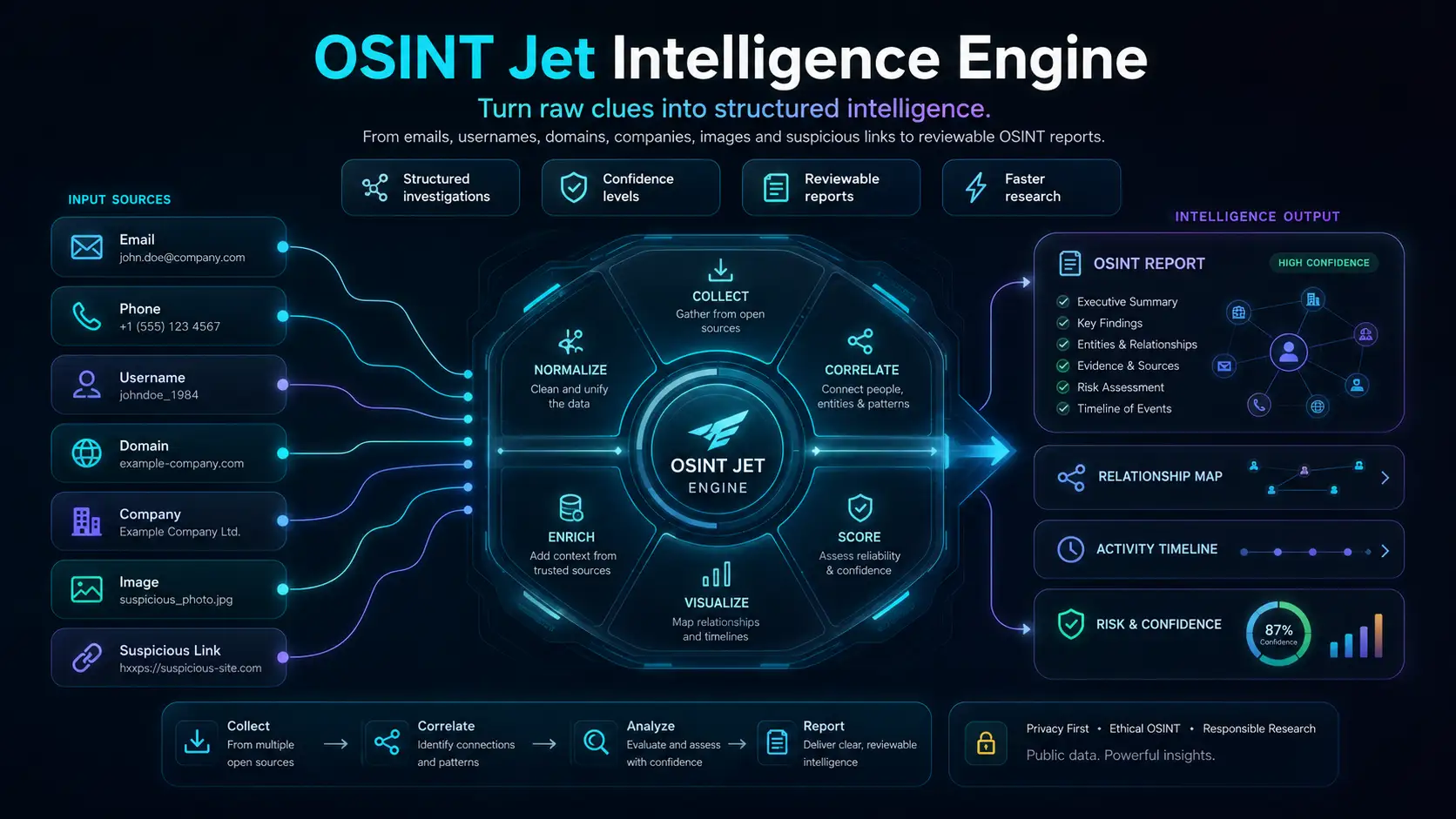
Deep internet research, without getting lost in tabs and tools.
In simple terms, OSINT means finding and analyzing public information that anyone can access. The hard part is that those signals are usually scattered, deep, and difficult to connect. You can spend days searching and still miss the relationship between an email, a username, and a domain. The OSINT Jet Intelligence Engine exists to solve exactly that problem. It helps organize the research around the relationships you need to understand, with findings and follow-up questions collected in one reviewable report.
OSINT Jet turns messy, fragmented research into a guided investigation path.
Instead of forcing you to juggle tools, searches, notes, and loose evidence on your own, the OSINT Jet Intelligence Engine keeps the case structured from the start and shapes the result into something you can actually review and use.
Raw clues become an organized path with findings, confidence signals, and next steps.
Findings are presented with uncertainty, limits, and context instead of false certainty.
Outputs are built for human review: summary, findings, risk, confidence, and follow-up clues.
Suggested follow-up clues stay reviewable and editable before any further action is taken.
Keep the research and reasoning in one case.
Manual searching is useful for simple checks. But when the case is multi-clue, time-sensitive, financial, reputational, or just messy, you need structure, confidence signals, and a report you can review later.
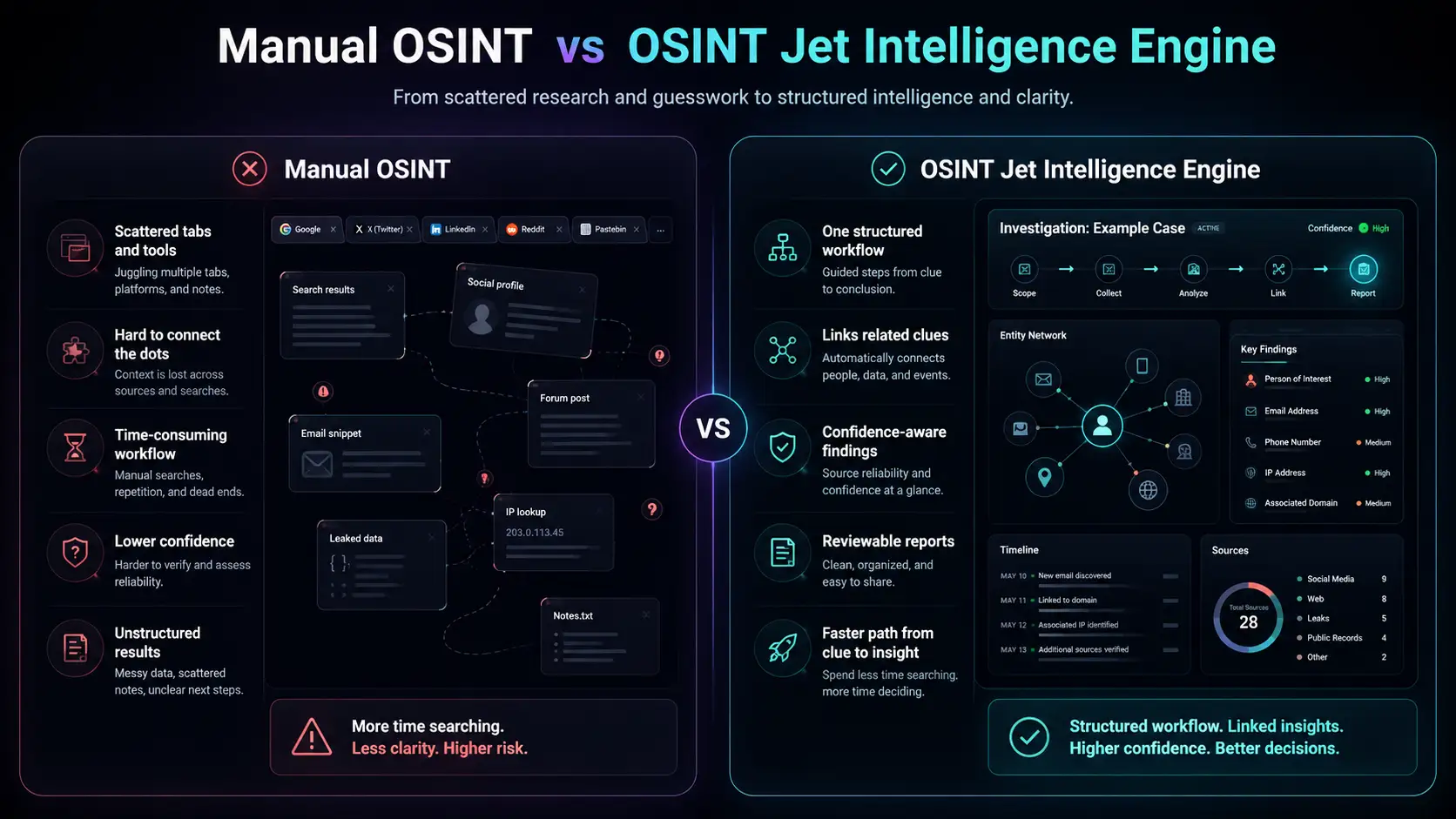
Manual searching & scattered tools
- Results get spread across tabs, notes, screenshots, and separate platforms.
- You have to decide on your own which signal is truly relevant.
- False matches, stale data, and premature conclusions become more likely.
- At the end, you still need to turn everything into a usable report yourself.
OSINT Jet Intelligence Engine
- Identifies clue types and builds the investigation path around the case.
- Organizes relationships, findings, and risks into one structured view.
- Shows confidence and limitations instead of implying certainty where none exists.
- Delivers a reviewable output that is easier to read, share, and continue.
From raw clue to report, through a structured OSINT process.
The engine is built around case structure, not disconnected search results. Each layer has a clear job so your input moves toward a more usable and reviewable outcome.
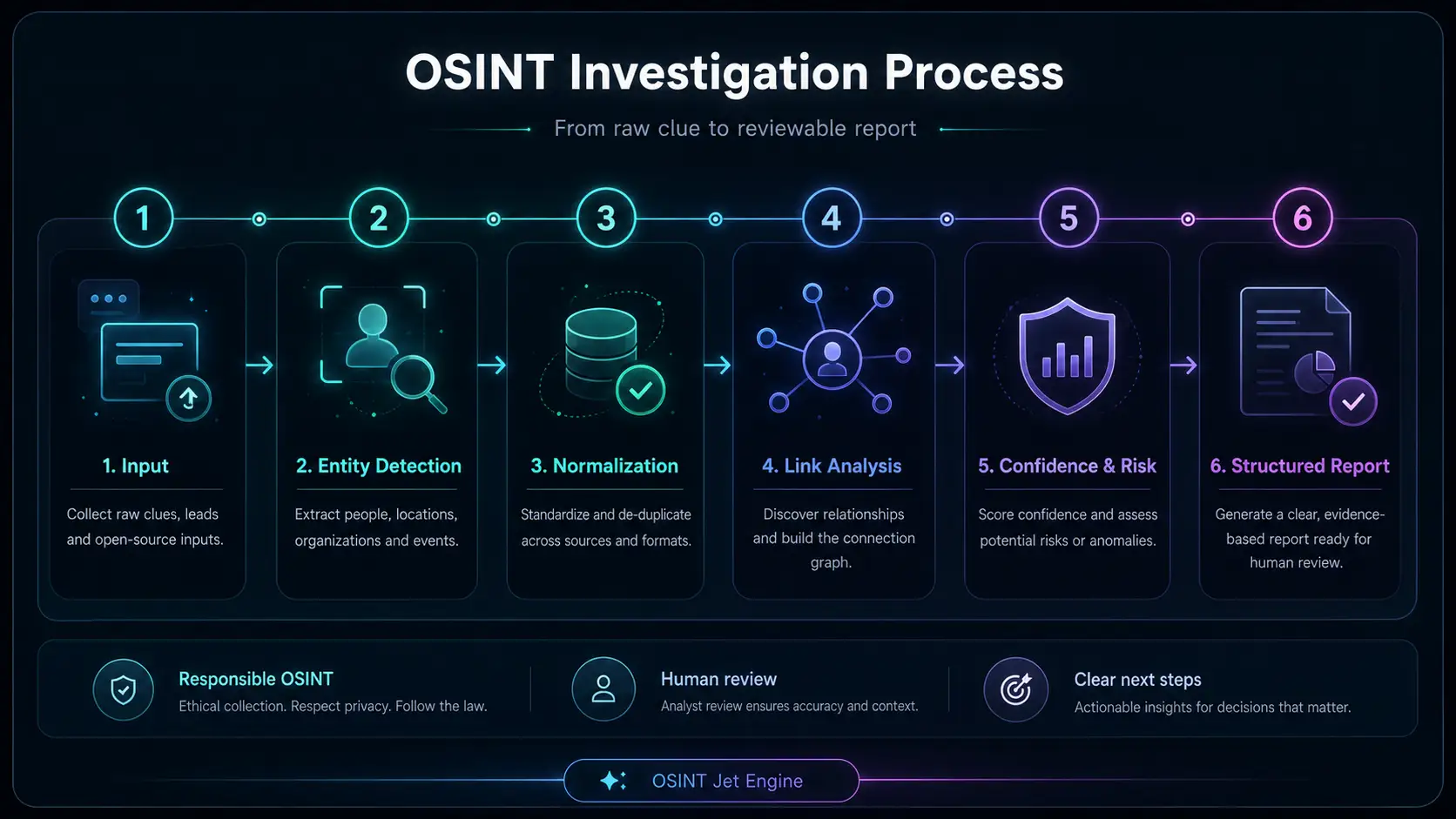
Input parsing
The engine reads the case text and separates useful clues such as emails, usernames, domains, names, numbers, links, and context.
Raw input → analyzable inputEntity detection
It identifies what kind of case this is and which clue types should drive the investigation path first.
Email / phone / username / domainNormalization
Variant spellings, mixed formats, aliases, and related patterns are cleaned up and organized for better review.
Variants and formattingFollow-up planning
The engine suggests logical next steps, such as checking a domain, company, email, phone number, or fraud indicators.
User-confirmed continuationCase mapping
Potential links are arranged so you can see which connections look stronger, weaker, uncertain, or still need review.
Relationships and confidenceReport building
The result becomes a readable report with summary, findings, risk context, confidence level, and next steps.
Decision-ready outputUse whatever you have right now.
Most OSINT investigations begin with incomplete information. What matters is placing that small clue into the right structure early.
Reports are built for human review, not blind trust.
A useful report should show what went in, what came out, which findings are stronger, what is uncertain, and what the next safe step might be.
A concise overview of the case, input quality, and the most important findings.
Findings are organized by relevance, strength, uncertainty, and the need for deeper review.
Signals can be labeled as stronger, likely, weak, conflicting, or in need of more verification.
Suggested follow-up clues remain visible and reviewable before the user continues.
The report is shaped around the case goal and the original clues, not just a pile of raw search results.
If a finding is not strong enough to stand alone, it should be marked with caution and context.
You can review, edit, keep, or discard suggested follow-up clues before moving further.
If the case is more sensitive or complex, a manual OSINT / VIP investigation path is available.
A simple test: enter the clue you already have.
Add a name, email, phone number, username, domain, company, image clue, suspicious link, or a short case description. The more context you provide, the more useful and reviewable the report becomes.
For example: email + username + country + reason for checking.
The output includes a summary, findings, risk context, and confidence signals.
You can review, save, edit, or continue with suggested follow-up clues.
Built for people who need speed, structure, and decision-ready clarity.
The OSINT Jet Intelligence Engine is for users who do not want valuable context to disappear across dozens of tools and tabs.
Structure early-stage investigations, preserve case context, and turn loose signals into a usable path.
Fraud & scam reviewCheck a suspicious website, message, number, company, or seller before you trust or pay.
Company & claim reviewAssess business signals, domain context, public presence, and consistency of commercial claims.
Digital identity analysisCarefully connect email, username, domain, and public traces with confidence-aware framing.
Trust comes from transparent reporting, not oversized promises.
A strong intelligence product should explain what was found, why it matters, how reliable it looks, and what is still unclear.
Designed for lawful, ethical, and reviewable public-source research.
The OSINT Jet Intelligence Engine is designed for structured research in public sources, risk review, verification, and report building. Outputs should always be reviewed with human judgment, attention to source quality, confidence levels, limitations, and the laws that apply in your environment.
Move from the engine to the right supporting pages.
If you want to explore manual pathways, tools, and supporting educational pages before launching a full report, start here.
Common questions about the OSINT Jet Intelligence Engine
What does the OSINT Jet Intelligence Engine actually do?
It takes raw clues from the user, structures them into a case, shapes an investigation path, presents findings with confidence context, and turns the output into a reviewable OSINT report.
How is it different from a normal search?
A normal search gives pages and links. The OSINT Jet Intelligence Engine turns clues into a structured case with linked findings, confidence signals, and a clearer report.
Is it suitable for beginners?
Yes. Even if a user only has one small clue, the page and report flow are designed to make the next step clearer and easier to understand.
Are all findings certain?
No. In OSINT, you can run into stale data, name collisions, weak signals, and matching mistakes. That is why confidence levels and limitations should be visible in the report.
Does continuation happen automatically?
No. Follow-up investigation should happen with user review and confirmation. Suggested clues can be reviewed, edited, selected, or discarded before the next step.
What if the case is more sensitive or complex?
For more complex, high-sensitivity, or high-context cases, you can use the manual OSINT / VIP pathway so the case can be reviewed before full work begins.
Have a clue? Turn it into a structured investigation.
Add an email, phone number, username, domain, company, image clue, suspicious link, or a short case description. The OSINT Jet Intelligence Engine structures the path and turns the result into a reviewable report.
Give the AI a question worth investigating
Suppose you have an email, a company website and a public profile that seem connected. Three separate searches can leave you with three disconnected answers. OSINT Jet brings those inputs into a case: identify the clue types, normalize their formats, investigate relevant public signals and organize the relationships and findings for review.
The difference becomes clear when you need to explain the result. A useful report keeps the question in view, shows what was found and separates stronger connections from leads that still need checking. You can review the proposed next clues before deciding whether to continue.
A stronger starting brief
My question: Is this website publicly connected to the company being named?
Clues I have: exact company name, domain, email and relevant public profile URL.
Context: where each clue appeared and when I obtained it.
The inconsistency: the message uses a different domain from the public contact page.
What I need: supported connections, unresolved claims and useful next checks.
Illustrative input, not a product result. Replace the example with the relevant facts of your own authorized case. Include only information needed to answer the question.
Choose the amount of help the case needs
Use free utilities for a small formatting or preparation job. Choose a standard report when you need several clues organized and investigated together. For contradictory or complex evidence, the manual review route lets you define a separate scope.
A standard text report is currently listed at 100 credits; the 50-credit signup balance covers part of that requirement. See the current packages and optional costs, then start with the question you actually need answered.
Published by OSINT Jet Editorial Team · Reviewed 10 September 2026
Explore this topic
Put your next case into context
Bring the exact question, the clues you already have and the contradiction you need resolved. Check the report options before adding credits, and use the report template to decide what a useful answer should contain.