
OSINT Jet · Business evidence
Online Review OSINT: Test the Evidence Behind the Stars
Twenty glowing comments can describe twenty customers—or several copies of one claim. Before a rating changes your decision, check what the reviews actually say, how you selected them and whether their sources are independent.
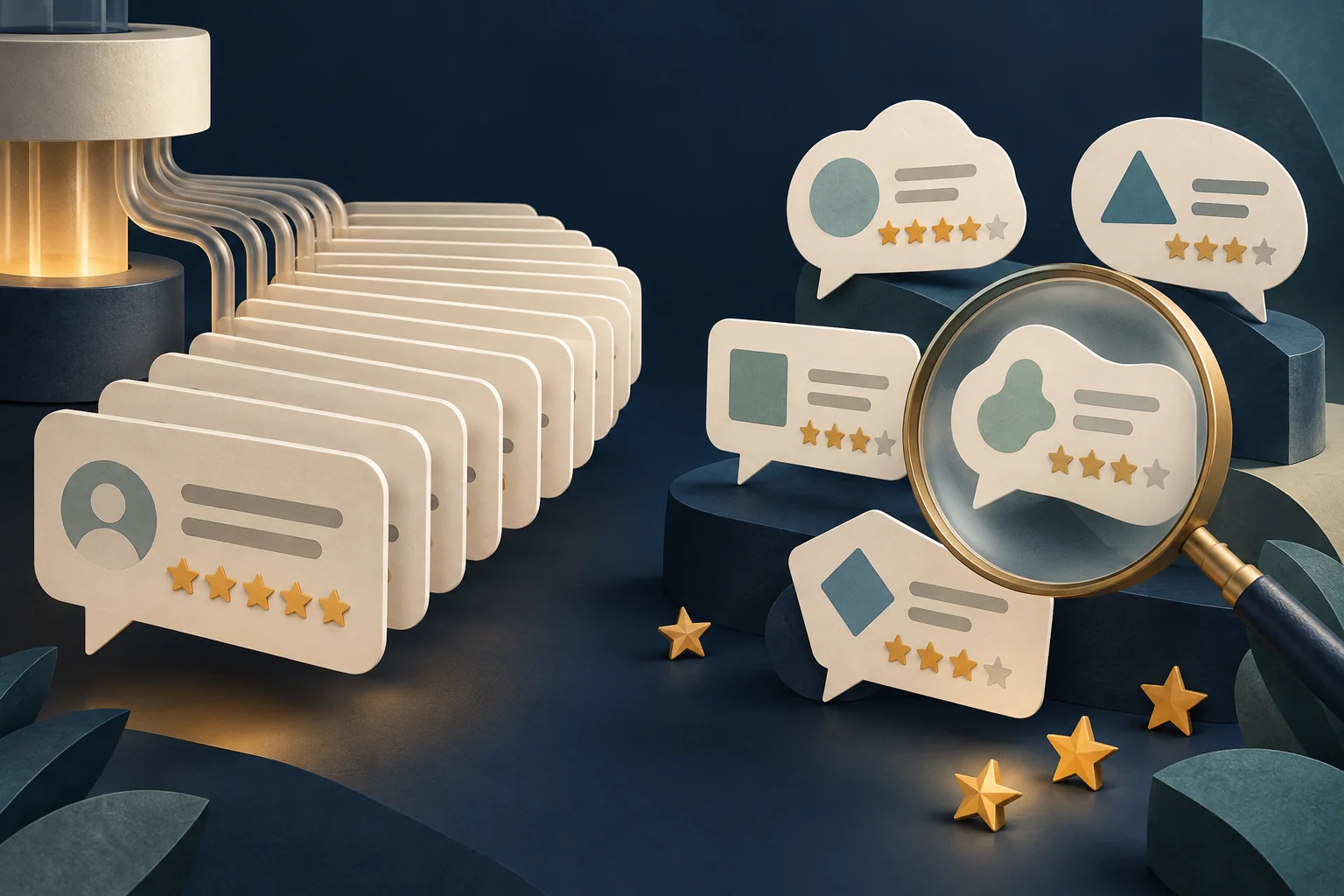
Choose a buying question that reviews can answer
“Is this business trustworthy?” is too broad for a star average. Try a narrower question: “Do recent reviewers describe receiving the item shown?” or “What happens when a customer asks for after-sales help?” Those questions let you distinguish a relevant account from enthusiastic but uninformative praise.
This is a method for evaluating public claims, not for identifying anonymous reviewers. Keep the focus on the business, the review text and its visible context. Do not seek a reviewer’s private contact details or treat a pseudonym as an identity problem to solve.
The FTC’s consumer guide recommends examining the source and consulting varied review sources. It also cautions that spotting deceptive reviews is difficult. Your output should therefore be an evidence note with limitations, not a percentage claiming that an account is fake.
Fix your sample before you pick a side
A “most relevant” sort can display a different slice from “newest.” Searching only for complaints selects for complaints. Neither view estimates the experience of all buyers.
For a small review, record the platform, listing URL, sort setting, visible total and observation date. Then describe a repeatable selection rule. For example: read the newest 12 visible reviews, plus up to four lower-rated comments specifically about the service you need. That is a convenience sample for finding issues, not a statistical survey. If the platform exposes only five reviews, record five; do not pretend you saw the rest.
Keep the added negative comments in a separate group. Otherwise, you could accidentally report the share of complaints in a sample you deliberately filled with complaints.
Make a claim map, not a fake-review score
| Observation | Question it opens | What it does not establish |
|---|---|---|
| The same unusual sentence appears repeatedly | Is it copied, a prompt, a quotation or syndicated content? | That different accounts share an operator |
| Many reviews appear close together | Was there an event, launch, backlog or review invitation? | That a coordinated fraud occurred |
| A badge says “verified” | What exactly does this platform verify? | Every factual claim in the comment |
| A detailed complaint describes one transaction | Can the relevant public context be checked? | The experience of every customer |
A useful map gives each statement a job: product description, delivery experience, support response or a claim you cannot classify. An adjective such as “amazing” may express genuine satisfaction while offering little help with your specific question.
Worked example: a launch-day cluster
Invented teaching scenario. No real store, reviewer or OSINT Jet customer is being assessed.
A fictional repair shop has 18 visible comments in your chosen sample. Ten appear on the day a new branch opened. Six use the same unusual phrase; two of those six appear on a second site. Your question is whether the shop handles repairs well after the first visit.
The weak conclusion is “most reviews are fake.” A stronger note separates four observations:
- The dates cluster around an opening, so the timing has at least one plausible ordinary explanation.
- Repeated text deserves a source check; it is not six independent descriptions of repair quality.
- The second site may reproduce the first site’s material. Until the relationship is understood, do not count those two copies as extra corroboration.
- Most comments concern the opening or friendly staff, so they leave the after-sales question largely unanswered.
You can now ask for clear service terms or look for accounts describing later visits. That decision is more useful than declaring the whole business safe or dishonest.
Trace a distinctive claim without collecting a person
Search a short, unusual, non-sensitive phrase in quotation marks. Inspect a matching page and its context. A match could be a quoted testimonial, an aggregator, a copied complaint or an unrelated commonplace sentence. Record the relationship only when the source supports it. No match merely describes that search.
If a review attaches an image, compare the image’s claimed role with its public context using the image investigation workflow. A reused manufacturer photograph may explain a product; it does not demonstrate the reviewer received it. Keep that narrow conclusion rather than guessing the reviewer’s identity.
Google’s review policy requires genuine experience and prohibits specified forms of fake engagement. Those rules explain the platform’s standard; a review remaining visible is not proof that it has passed a forensic investigation.
Write the result so somebody else can challenge it
Decision this review should inform:
Listing, platform, date and sort order:
Selection rule and number actually read:
Relevant transaction or service claims:
Copied or syndicated material, with source links:
Ordinary explanations still possible:
Evidence missing for the decision:
Next check that could change the conclusion:
Save only relevant public excerpts and links. A result such as “the visible sample mainly describes the opening event and does not answer the warranty question” is a useful finding. It does not accuse anybody, and it identifies exactly what information to seek next.
Use a structured case when the reputation story crosses sites
For one clear review, a short note may be enough. If a business uses several listings, websites and copied testimonials, OSINT Jet’s company workflow provides a route to organize the public relationships and unresolved claims. Include your sample rule and the specific buying question so the case does not become a pile of star counts.
Check report and credit options when that wider organization would help. If contradictory sources need closer interpretation, request a defined manual review. The useful deliverable is a traceable explanation of the evidence, not a guarantee about the next purchase.
Published by OSINT Jet · Original publication: 29 September 2026