Image research · Reading provenance without overclaiming
Content Credentials in OSINT: what an image’s history can actually tell you
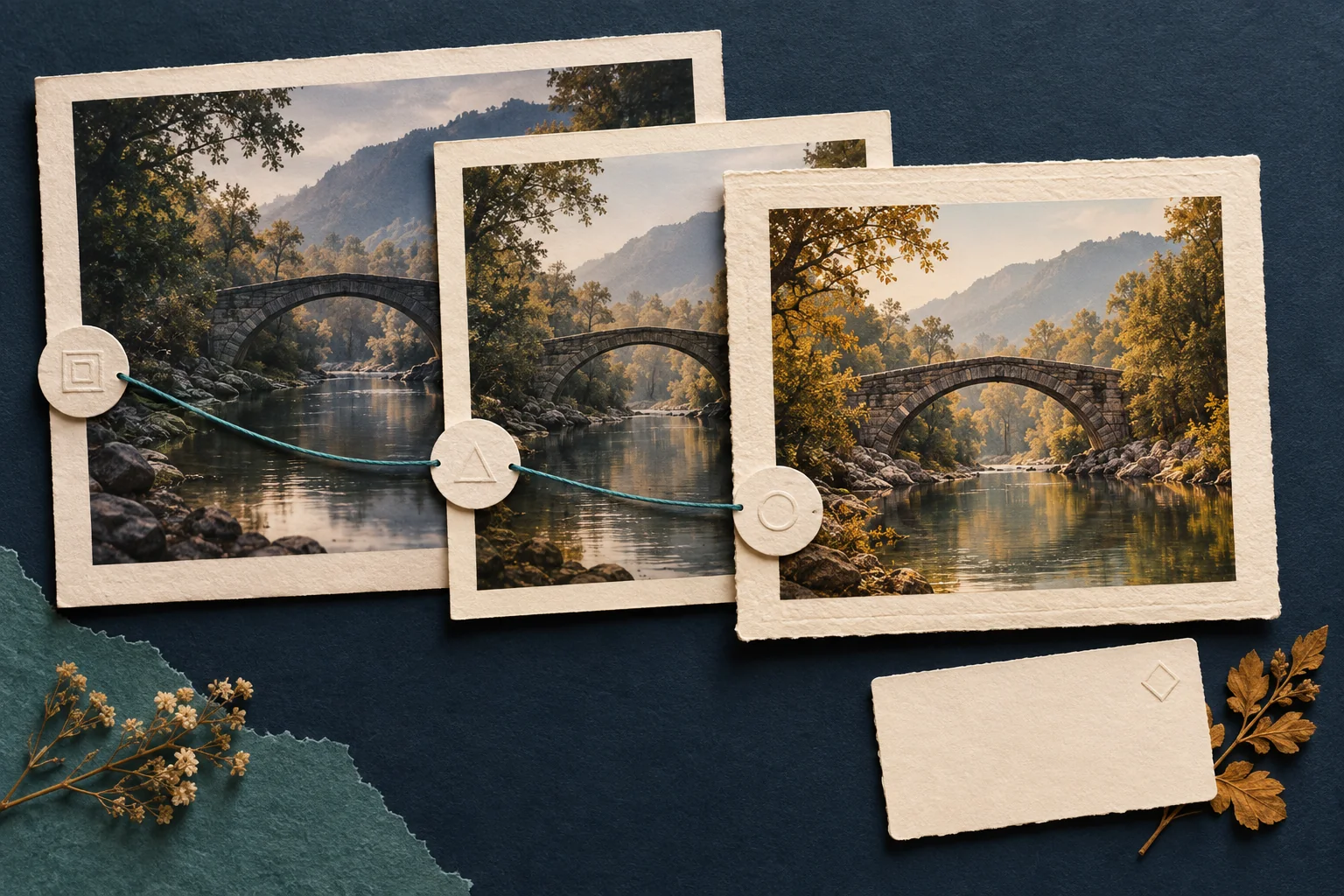
A photograph of a bridge arrives with a caption: “Taken this morning.” Its Content Credentials show a recorded edit history. You now have something useful to examine, but the word “morning” still needs evidence of its own.
That distinction is the point of this guide. C2PA-based Content Credentials can help you inspect a file’s recorded provenance: where it came from and what happened to it. Your research question may instead concern the event, location or date described by someone who shared it. Keep both questions visible.
Start with the file, not a screenshot of a badge
The Content Credentials pin opens information about media provenance in supporting interfaces. A picture of that pin does not reproduce the underlying inspection. Ask which exact file was examined and open its available provenance details yourself.
Keep the lawful copy you received unchanged, along with its source URL, filename and collection time. Inspect a duplicate. If the only available copy is a screenshot or a resized export, say so before interpreting a missing result. Do not upload confidential evidence to an online verifier without an appropriate basis for sharing that file.
A useful public starting point is the Verify link provided by the official Content Credentials site. Tool interfaces and supported formats can change, so record the verifier and version where shown rather than relying on a remembered green icon.
Read the result in five separate passes
C2PA stores signed statements about an asset in a manifest. Its technical specification distinguishes a valid manifest from a trusted one and separately checks the asset’s content binding. A valid manifest alone is not the same conclusion as a valid asset. These are technical states, not verdicts on a news story. See the C2PA specification’s validation and trust sections.
- Presence: did this tool locate a credential for this copy? Write the exact result. Do not silently replace “not found” with “never existed.”
- Validation: what passed, failed or was not checked? Record which manifest and asset the result refers to. If an error is reported, keep the error text.
- Trust: how does the verifier describe the signing credential under its trust settings? Do not convert a software or certificate label into a person’s identity.
- History: which actions and source assets are actually recorded? Separate displayed history from the checks you personally completed.
- The claim: what does the caption ask you to believe, and which part remains untested? Write that as a normal sentence.
For the bridge example, the fifth line might be: “We still need evidence that this bridge was photographed today.” That sentence stops a technical result from swallowing the original question.
Missing information has several possible explanations
C2PA’s official FAQ explains that provenance metadata can be separated from a file. Supported fingerprinting or watermark mechanisms may help rediscover it. It also explains that checking source ingredients fully requires their actual data; a record of an earlier check is different from repeating that check now.
These limits suggest different next actions. If nothing was found, seek a better source copy when available. If the main file passed but an ingredient was not available to you, describe the narrower scope. If the verifier reports a content-binding failure, preserve the failed result and investigate which copy or stage caused the discrepancy. None of those situations requires guessing the sender’s motive.
Provenance alone does not establish factual truth, and a recorded history can be incomplete. The C2PA explainer makes both limits explicit. A genuinely old image can accompany a misleading current caption; an edited image can describe its edits honestly.
Practice with three investigation notes
These are invented teaching scenarios. They are not results from a real C2PA tool run, and the labels below are plain-language summaries rather than guaranteed interface wording.
| What the researcher has | What the note should preserve | Useful next work |
|---|---|---|
| The supplied image passes the reported asset checks; the signer is trusted under the tool’s policy; a crop is recorded. The accompanying post says “this morning.” | The technical results and recorded crop, followed by a separate unresolved date claim. | Find earlier publications and ask what independently dates the scene. |
| A messaging-app copy has no credential located by the chosen verifier. | No credential found in this copy by this tool. Creation method remains unknown. | Seek the publisher’s source file. Continue visual and publication-source research if none is available. |
| The main asset passes, but a source image mentioned in its history is unavailable for your own check. | Main-asset result, the referenced ingredient and the exact limit on independent checking. | Obtain that ingredient lawfully if it matters to the claim; otherwise report the gap. |
Notice how the next task changes. Running the same check again on the same copy will not answer every unresolved question. For the first scenario, tracing earlier image publications is more relevant than collecting another screenshot of the provenance panel.
A provenance box for your research notes
Use this short worksheet beside, rather than in place of, your assessment of the pictured event. Fill unknown fields with “not available” and retain the tool’s own wording.
File examined and source:
Original download, export, or screenshot:
Collection time and file hash, if recorded:
Verifier, version, inspection time, trust settings shown:
Credential found? Exact message:
Manifest validation / asset-binding result:
Signer or generator details actually displayed:
Actions and ingredients recorded:
Which ingredients I could independently check:
Caption or event claim still needing evidence:
Next source that could resolve that question:
A file hash helps distinguish copies in your notes; it does not certify the depicted event. Ordinary photo metadata such as EXIF can supply additional leads, with its own limitations. Avoid blending all those observations into a single unexplained “authentic” score.
Use the remaining question to scope the work
If the file history answers your question, stop there. When it leaves an important gap, state it precisely: “Can we find an earlier public appearance of this image?” is a more useful research brief than “Prove this picture is real.”
For a case that needs further work, you can use OSINT Jet’s specialist investigation request to discuss that unresolved question and a separately quoted scope. Include the bounded provenance note and public source references. This guide does not claim that OSINT Jet contains a C2PA verifier or that any investigation can guarantee a final answer.
Published by OSINT Jet Editorial Team · 5 October 2026