
OSINT Jet · Account continuity
Username Changes in OSINT: Does the Old Handle Still Mean the Same Account?
An old conference page links to a speaker’s social profile. Today, that link opens a shop selling unrelated products. Before you connect the shop to the speaker, check what changed. The address may have survived while the account behind it did not.
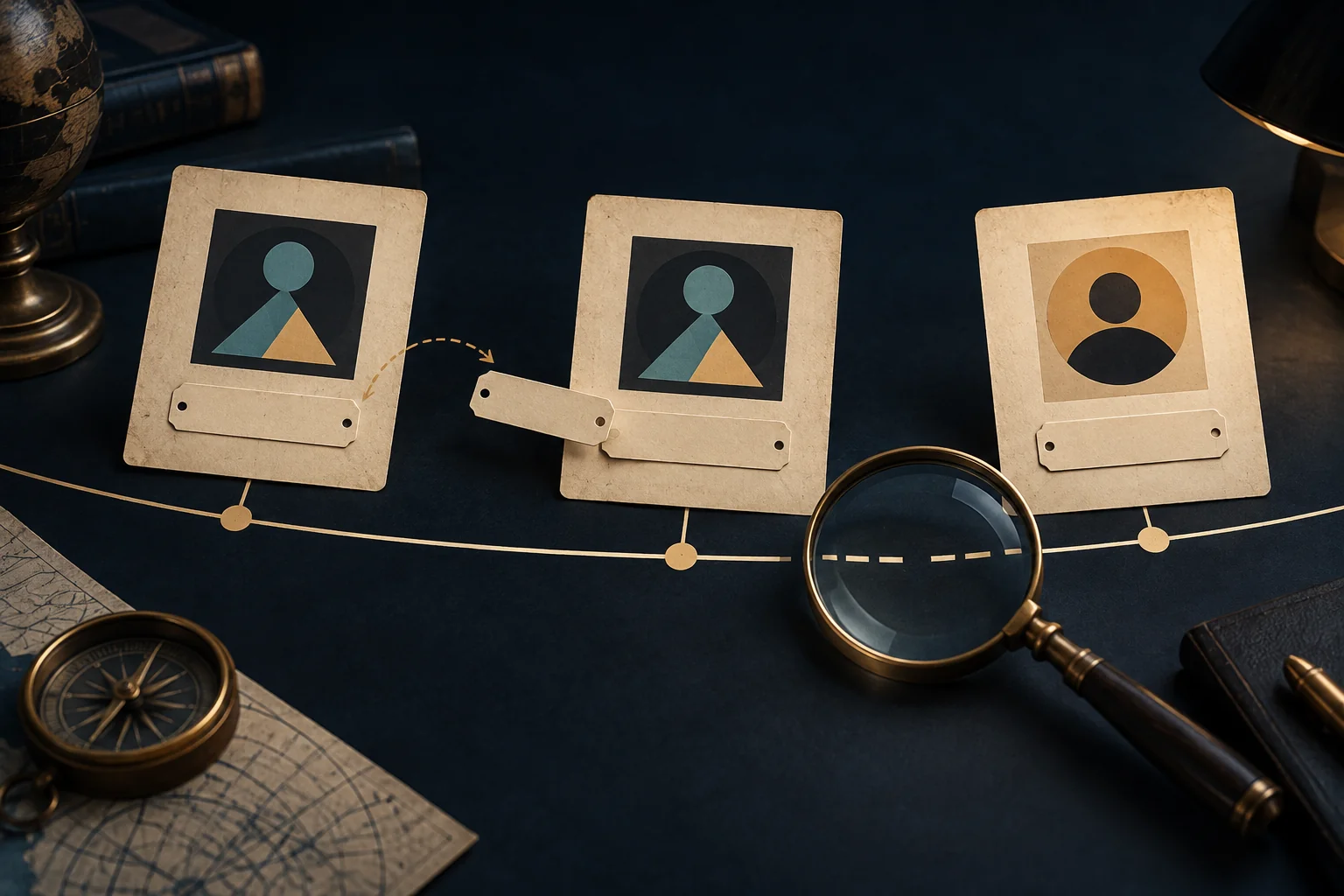
Separate the label, the account and the person
A handle is the name you can type into a platform’s search box. A profile URL is a route to a page. An account is the platform record behind that page. The person or organization operating it is another question. Those four things often move together, but your investigation should not assume that they always do.
This distinction matters when you review an old professional reference, a public project or a claimed business relationship. You are asking whether evidence from one period belongs with evidence from another. Collecting more present-day profiles cannot repair a missing connection between those periods.
For initial discovery and candidate checking, use the username OSINT guide. This article begins after you have found a candidate and need to decide whether its history is continuous.
Check the platform’s rule before interpreting a broken link
X’s username guidance says a former handle becomes available to others after a change. A current match can therefore point to a different account. That rule concerns renaming; do not assume every suspended or deactivated name becomes available immediately.
GitHub documents different behavior for profile and repository links: the old profile link returns a 404 after renaming, while repository references normally redirect. Reuse of an old owner-and-repository name can override a repository redirect. A project link and a profile link are not interchangeable evidence.
Record which kind of URL you checked. A 404 alone does not tell you whether an account was renamed, removed or never existed at that address. A redirect establishes where a request goes now; it does not identify every past operator of that destination. When a platform’s behavior is unclear, leave the continuity question open.
Build a continuity record with two clocks
Every observation needs an evidence date and a check date. The evidence date describes the period represented by the source. The check date says when you examined it. A biography published in 2022 and inspected today is still evidence about the biography’s claim in 2022, unless the page supports a newer claim.
| Record | What to keep | Why it matters |
|---|---|---|
| Old reference | Exact URL, context, named platform and the source’s date | Shows what was linked at that time, without assigning today’s profile its history |
| Current destination | Final URL, visible handle, public description and check time | Separates a current observation from an old claim |
| Bridge | A dated rename notice, an independently located official link, or an appropriately documented public account identifier | Explains why two observations may concern one account |
| Counterevidence | A different business, conflicting chronology or an explicit disavowal, with its source | Prevents a convenient match from hiding a contradiction |
If a public interface supplies an account identifier, record the platform and the documented meaning of that identifier. Do not invent permanence because a value looks numeric. Even a supported match to one account record does not establish who operated it throughout its lifetime.
A worked example: one old link, two plausible stories
Fictional teaching case, not a customer investigation. A 2022 event brochure associates the placeholder handle HANDLE_A with a designer. In 2026 the same profile route shows a furniture shop. The designer’s independently located portfolio now links to HANDLE_B.
Story one: the designer renamed the account, and another account later obtained the old handle. Story two: the original account itself changed purpose or operator. The facts above do not choose between these stories. A matching avatar would not settle it either; images can be copied.
Suppose the portfolio also contains a dated announcement linking the old and new handles. You now have a direct public claim of a rename. Attribute that claim to the portfolio and record its date. Do not turn it into a finding that the furniture shop belongs to the designer. The old event link remains a historical reference that needs updating.
A useful conclusion is: “The event brochure linked to HANDLE_A in 2022. The portfolio currently endorses HANDLE_B and reports a rename. No reviewed source establishes a relationship between the designer and the present shop using HANDLE_A.” That sentence preserves both the connection you found and the one you did not.
Decide what you can join—and what must stay separate
Give each proposed connection a short written reason. “Same spelling” is a discovery reason. “Official portfolio links to the current profile” supports a present association. “Dated rename statement connects both handles” supports a claimed transition. These are different findings, not points to add into a magical identity score.
Stop when your original question is answered. To correct an outdated speaker link, a current authoritative profile link may be enough. To attribute a historical statement to a present operator, you need evidence about that period and control of the account. If the bridge is missing, report the gap instead of searching private accounts or provoking a password-reset message.
Bring the timeline into a structured investigation
When several aliases, organizations and old links conflict, a raw list of handles becomes hard to review. OSINT Jet’s username investigation workflow is presented around organizing public clues and their relationships. Give the case the exact URLs, the two dates for each observation and the unresolved transition. Ask for sources supporting each connection, rather than a list that silently merges every matching name.
For a simple broken link, the platform documentation and an official reference may finish the job for free. For a wider case, compare report and credit options. If a disputed timeline needs closer assessment, the manual investigation request lets you describe that specific question; a request is separate from commissioning the full investigation.
Published by OSINT Jet · Original publication: 29 September 2026