
OSINT Jet · Image verification
Reverse Image Search for OSINT: Trace the Source, Not Just the Match
You found a striking image in a post. A reverse image search returns dozens of copies. Which one is the source, and what can you actually conclude? This guide turns a pile of matches into a small, checkable history of versions.
Decide what “source” means in your case
A visual match does not answer every question. You may want the creator, the first public publication, the earliest indexed copy, the page that a particular account borrowed from, or the full-resolution file. Write down which one matters. Those are different claims with different evidence.
Reverse image search is especially useful when a post implies that a photo was made for today’s event. Finding an older appearance can challenge that timing. It does not by itself identify the photographer or prove that the older page held the original file. If your question is where was the scene photographed?, use the separate image geolocation guide. Here we follow publication and reuse.
Search the whole image, then the useful parts
Save the exact page URL and the image as encountered, along with the date you saw them. Search the full image first. Google’s image search help explains that results can include similar images and pages containing the image or a similar one. Treat each result as a lead, not as an attribution.
Then crop a distinctive, non-sensitive region: a painted sign, a building edge, or a specific arrangement of objects. Search that crop separately. A repost may add a border, caption or color filter, so the full frame can miss a closer relative. Record which crop produced each match. Do not upload a private photograph or sensitive personal document to a third-party search tool without a lawful reason and an appropriate privacy decision.
| Result | What to compare | Why it matters |
|---|---|---|
| Same composition | Fixed objects, perspective, tiny defects | Suggests a copy or derivative, not necessarily the first copy |
| Different crop | Which edges disappear, added border or overlay | Can show a direction of editing, but not always publication order |
| Page context | Byline, caption, links, update note, license | May identify a claimed source or a reuse trail |
| File detail | Resolution and available metadata | A larger file is not automatically older or original |
Our image OSINT overview describes broader visual analysis. This procedure focuses on the narrower question of which appearance supports a source claim.
Build a version timeline with three separate dates
For each promising result, note its page URL, the exact image variant, any stated publication date, the date you observed it and an archived capture if one exists. Open the page; a search thumbnail alone hides context. Follow the page’s source credit and outgoing links. Search the distinctive caption or filename only as additional clues, because copied captions travel with copied images.
A search engine’s “oldest” sort may mean its own first crawl. TinEye says explicitly that its oldest result reflects when TinEye first crawled the image, not when the image first appeared online. A visible article date may also be edited, imported or backdated. An independent archived capture can corroborate that a page existed by its capture date, subject to the archive’s gaps. The Internet Archive’s guidance explains why missing captures are not proof that a page did not exist.
Write a timeline row as “observed online by [date] in [capture or crawl], page states [date], attributed to [named source].” That sentence keeps observation, page claim and attribution from collapsing into one unsupported “first published” claim.
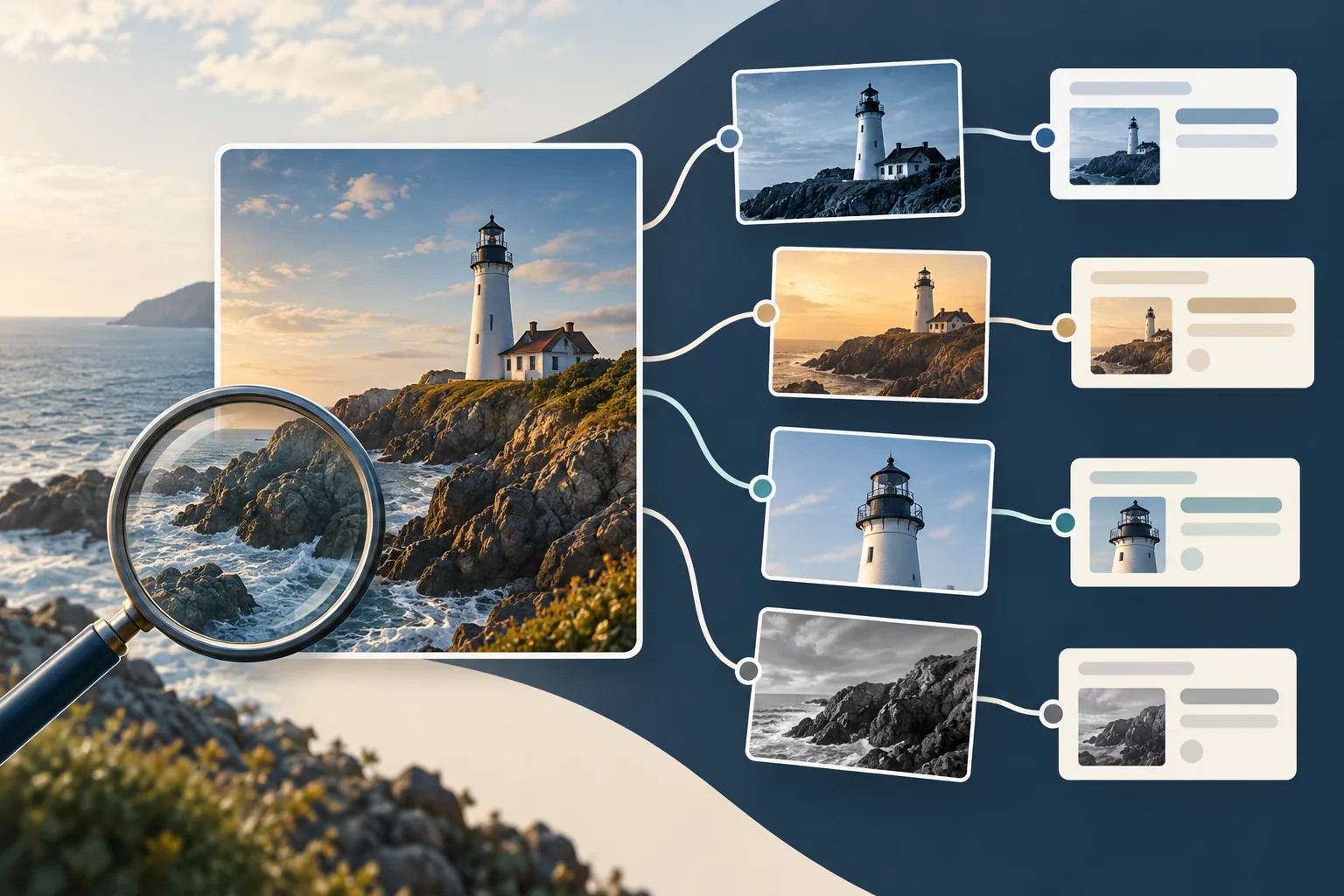
A fictional lighthouse photo with four apparent sources
Invented exercise: a current post presents a lighthouse photo as today’s storm. Searching the full frame finds a travel blog with the same sky and railing, a cropped postcard listing, and a news article with a cooler color grade. Searching only the distinctive railing finds an older archived blog page. The postcard page gives no photographer credit. The news article links to a stock-photo license page, but the stock page has no visible capture before the blog archive.
Your defensible statement is: “This scene appears in an archived blog capture that predates the current storm post; the current post’s implication of a newly taken photo is unsupported.” You cannot yet say the blogger took the photograph. The travel blog might have reused it, and the archive does not necessarily contain the earliest online appearance. A larger version on the stock site is useful for visual comparison but is not a birth certificate.
Now inspect the current post for a credit or link and compare its crop to the other variants. If it shares the postcard’s exact border and scratch, that suggests a copying path; mark it as an inference. If none share those details, leave the path unresolved. The exercise ends when the claim you need to assess has enough support, not when every copy on the web has been found.
What a match cannot prove
No results may mean the image is new, poorly indexed, blocked, heavily edited or simply missed by the service. One service’s date is not universal. A credited photographer may still need confirmation through a portfolio, agency record or direct rights information. An EXIF timestamp concerns a file version and can be changed; it should not be treated as a capture date without checking the file’s history.
Keep your notes proportionate: original claim, search method, candidate pages, strongest dated appearance, alternate explanation and remaining question. The Berkeley Protocol offers a more formal model for identifying, preserving, verifying and analysing online material in its own human-rights setting. An ordinary verification task can borrow the habit of separating those steps without claiming a forensic conclusion it has not earned.
Choose the next check, or stop
If a dated earlier appearance resolves a low-stakes question, stop and record the limitation. If a business or safety decision depends on who created or authorized an image, ask for the original publication context or a reliable independent source. Do not use a visual resemblance to identify a private person.
OSINT Jet can help organize a wider investigation when an image is one clue among a domain, account or company claim. A useful request states the exact image claim and the decision it affects; it should ask for a traceable explanation rather than “find the original at any cost.” See the report template for how findings and limits should be documented, or check current options if you need a report.
Published by OSINT Jet · Original publication: 29 September 2026