
OSINT Jet · Identity research
Full Name OSINT: Separate Namesakes Without Guessing
A name is a search label, not a unique identifier. The responsible way to investigate a full name is to build separate candidate records, compare independent anchors and stop when the evidence cannot distinguish one person from another.
First decide what you actually need to know
Searching a common name without a precise decision produces a pile of profiles and a strong temptation to merge them. Start with a bounded question such as: “Is the author of this 2024 paper the same Nadia Rahimi listed on this laboratory page?” That question tells you which facts matter: publication, affiliation and time. It does not require finding a home address, relatives or every account with a similar name.
Write the minimum starting data you received and label its source. A name printed on a document, supplied by a client or remembered by a witness has a different reliability level from a name on an authenticated profile. If the spelling itself is uncertain, record that uncertainty before searching.
Build one candidate card for every plausible person
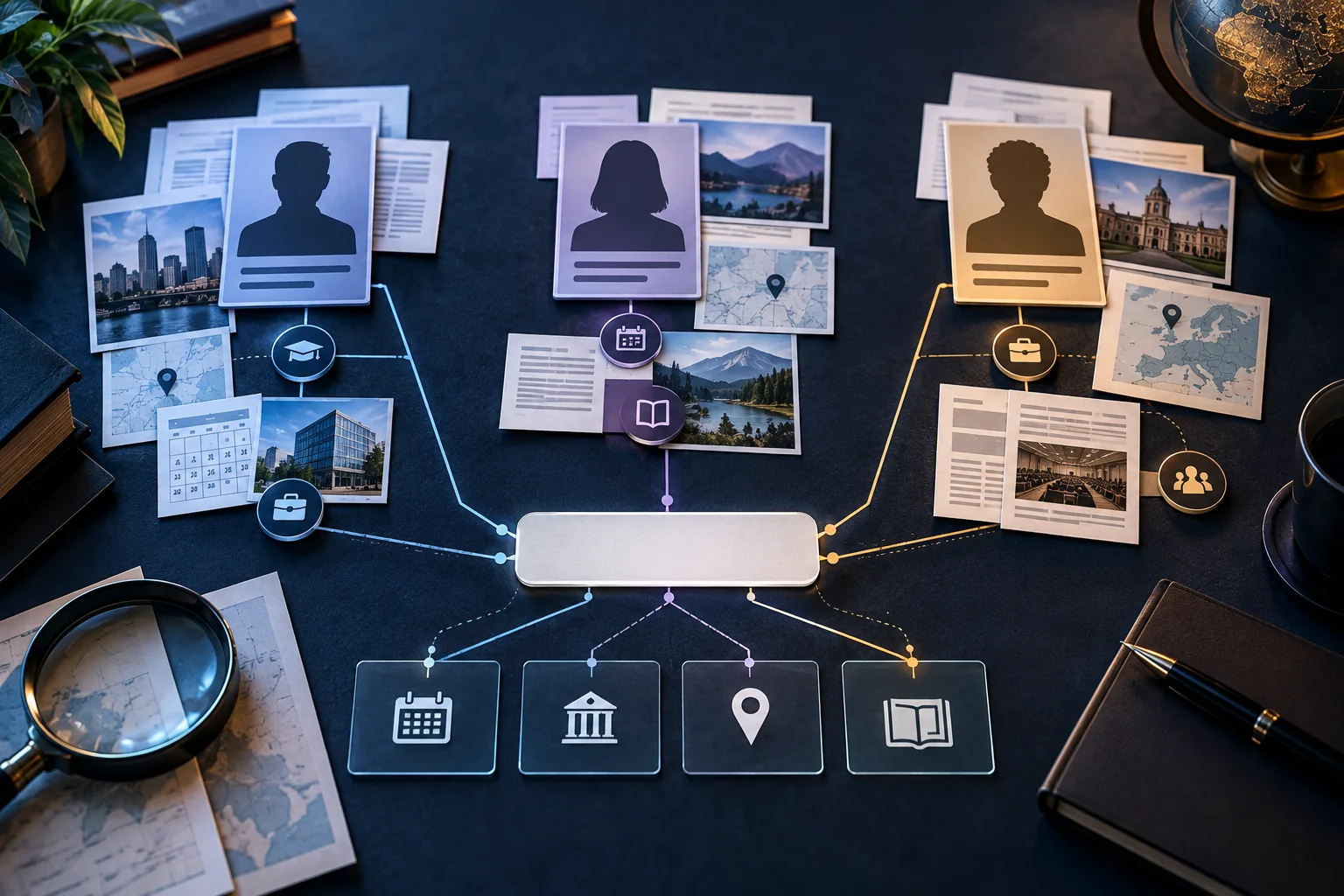
Do not keep all findings in one note headed with the name. Create Candidate A, Candidate B and Candidate C as soon as results diverge. Each card should contain only facts supported by its own sources:
- exact displayed name and spelling;
- role or field;
- organization and place;
- active dates or dated work;
- authenticated or institution-controlled identifiers;
- source URL, retrieval date and a short quote-free observation;
- contradictions and unknowns.
This structure prevents “identity bleed,” where a job from one namesake, a photograph from another and a publication from a third accidentally become one fictional person. If a fact cannot yet be assigned, keep it in an unlinked evidence list rather than guessing.
Compare six anchors, then test the contradictions
| Anchor | Useful evidence | Common trap |
|---|---|---|
| Name form | Full spelling, initials, middle name, native-script version and documented aliases. | Treating a transliteration variant as proof that two records belong together. |
| Time | Dated publications, archived staff pages, licenses or event programs. | Ignoring that roles and affiliations change. |
| Place | Organization location, stated city or event venue. | Turning a company office location into a person’s residence. |
| Organization | Institution directory, employer biography or registry filing. | Counting copied biographies as independent sources. |
| Role and work | Research subject, profession, credited project or portfolio. | Assuming two people in the same broad industry are identical. |
| Stable identifier | Authenticated ORCID, institutional profile or another identifier connected by its owner. | Assigning an identifier from a name-only search. |
Contradictions deserve their own column. If Candidate A was documented at an event in Berlin on the same day Candidate B appeared in a live program in Toronto, the conflict may separate them. If one page is undated, it cannot establish a contradiction by itself.
For researchers, the ORCID Registry can connect a persistent identifier with a record. ORCID’s own guidance warns against assigning an ORCID solely from a name search; authenticated collection is safer. Crossref’s REST API and Metadata Search can expose publication metadata, but the names and affiliations still need verification.
Generate spelling variants without turning them into identity claims
Names written in Persian, Arabic, Cyrillic or other scripts can produce several Latin spellings. Search the native-script form when you have it, then test plausible transliterations. For Persian names, one vowel may disappear in English, a surname may be joined or separated, and endings such as -i or -y may vary. Initials create another collision: “N. Rahimi” has less identifying value than a full name.
Keep a small variant table with three columns: spelling, where it appeared, and whether a source explicitly connected it to the candidate. A search variant is a way to discover evidence. It is not evidence that the result belongs to your person.
Use quoted searches for the exact name, but also combine the name with one anchor at a time: institution, specialty, city, publication title or known date. Overloading the query with every clue can hide a useful contradiction.
Worked example: three Nadia Rahimis, one paper
This case is entirely fictional. The names, organizations and events below are invented to teach the method and are not OSINT Jet results.
You need to determine whether the “Nadia Rahimi” credited on a 2024 materials-science paper is the same person shown on a conference page.
| Candidate | Observed anchors | Conflict or gap | Status |
|---|---|---|---|
| A | Materials researcher; Northbridge Lab; 2024 paper; conference program names the same lab and paper title. | Conference page has no personal identifier. | Strong working match, still bounded to this work. |
| B | Urban planner; public council reports; same Latin spelling. | Different field and organization; no materials publication. | Separate namesake. |
| C | Research profile uses “N. A. Rahimi”; similar topic. | Affiliation and active years do not match; native spelling unknown. | Unresolved candidate, do not merge. |
The defensible finding is narrow: Candidate A is the best-supported match for the paper and conference appearance because the dated title and affiliation align. The evidence does not authorize attaching unrelated social accounts or biographical details. Candidate C remains separate until a reliable source connects the initials, affiliation and work.
A five-line finding that survives review
- Question: are the paper author and conference speaker the same person?
- Observation: both sources show the same full name, paper title, lab and year.
- Independence: the journal record and conference organizer are separate publishers.
- Limit: neither page supplies an authenticated personal identifier.
- Assessment: likely the same contributor for this paper; broader identity claims remain unverified.
Know when to stop
Stop when the defined question is answered at the required confidence, when further collection becomes disproportionate, or when results cannot distinguish candidates. “Unresolved” is a valid outcome. It is better than a confident false match that can harm an unrelated person.
Collect only what the legitimate task needs. Avoid sensitive personal details that do not improve identification, and do not contact relatives, employers or unrelated namesakes merely to close a weak lead. If the conclusion could affect hiring, credit, safety or a legal decision, require a human reviewer and stronger, authorized verification.
OSINT Jet can help keep supplied clues, candidate entities, sources and contradictions in a reviewable investigation. It is most useful here when Candidate A and Candidate C remain separate instead of being flattened into one profile. The system organizes public-source findings; it does not grant permission to intrude or turn a probable match into certainty.
Continue with the username OSINT guide, the digital identity graph method, the investigation checklist and the report template.
Questions people usually ask
Is a matching full name enough to identify someone?
No. A name narrows discovery but usually needs independent time, place, organization, work or authenticated-identifier anchors.
How many matching sources are enough?
There is no universal number. Count independent underlying evidence, evaluate contradictions and match the threshold to the consequence of being wrong.
Can I use a profile photo to merge two candidates?
A visual resemblance is weak and subjective. Prefer institution-controlled links, dated work and identifiers. Do not use automated face matching without lawful authority and a proportionate need.
What if two people cannot be separated?
Record both candidates and the unresolved gap. Do not transfer facts from either person into a combined profile.
Published by OSINT Jet · Original publication: 29 September 2026