
PUBLIC PATENT RECORDS · CHECKING A SELLER’S CLAIM
How to verify a company’s patent claim without confusing an application with a grant
“Patented worldwide” sounds reassuring on a product page. Ask for the publication number before deciding what the phrase means. That number can lead to a published application, a granted patent, or a related document that does not establish the seller’s claim at all.
You can do a useful public-record check without becoming a patent lawyer. The task is to connect the seller’s exact words to an identifiable record, its stage and the territory concerned. Determining whether a product falls within enforceable patent claims is a different, specialist task.
Ask for something you can actually look up
Save the product model, seller’s legal name and exact patent claim. “Patent pending,” “patented,” “licensed” and “our invention” do not make the same assertion. A number attached to one product line may not describe every product in the catalogue.
Ask for the complete publication number, including its country or office prefix and final document code, plus a link to the issuing office’s record. If you are given an application number instead, keep that label: an application identifier and a publication identifier are not interchangeable. A cropped certificate image is a starting clue, not the complete record.
A practical clarification message is: “For model X, please provide the patent publication or grant number, the countries relevant to this claim, and the name of the recorded applicant or proprietor. If your company is a licensee, please explain the basis of the claimed permission.” Use your real product identifier in place of X.
Locate the record, then read the code
Use the relevant patent office’s search or the public search services linked from WIPO’s patent guidance. Search the full identifier first. If you only have a name or title, use it to find candidate records, then compare the document number, applicant, dates and invention details. A similar title is not enough to establish a match.
The letters at the end of a publication number describe the kind of document. Their meaning depends on the office and document series. For European publications, the EPO’s kind-code table identifies A1 as an application published with its search report, A2 as an application published without that report, and B1 as a granted patent specification. A WO A1 is an international application publication with a search report. Do not apply one office’s code meanings to every country.
This reading prevents a common shortcut: an impressive technical PDF with an A-code can be a real public document while still failing to establish that a patent was granted. “Document found” and “claim verified” belong in separate boxes.
A family connects records; it does not merge countries
Related applications may appear together as a patent family. Use those links to discover further records, but record each relevant jurisdiction and document separately. A family member’s grant is not a grant for all the other members.
WIPO explains that the PCT system provides an international application route; national or regional offices handle the grant of patents. A WO publication is therefore not a worldwide grant. Ask what country or regional right the seller actually means.
For European records, open the European Patent Register and read the procedural record. When checking national post-grant status, follow the relevant national register. The EPO’s status guidance distinguishes its own proceedings from supplementary national information; it also identifies the Unitary Patent section. Do not treat one summary badge as an answer for every territory and date.
The hinge supplier: a short worked case
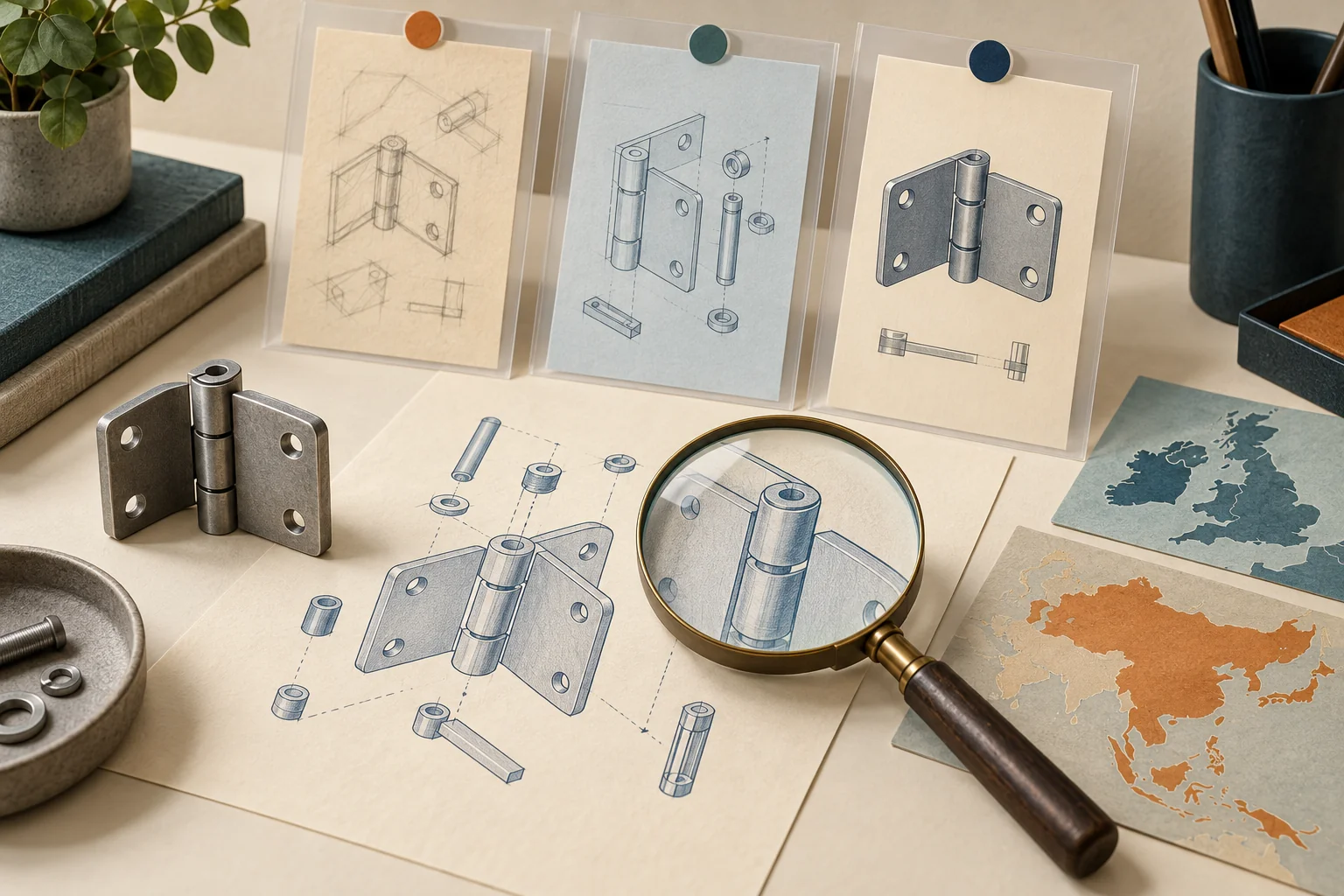
Invented example. A supplier markets a folding hinge as “our worldwide patented design.” It sends you a WO application publication and a related EP A1 record. Both describe a hinge mechanism. No real company or patent number is used in this exercise.
Your first finding is straightforward: there is an identifiable published application corresponding to the supplied documents. Your second finding is a limit: those documents alone do not demonstrate a granted right, worldwide coverage or a current right held by this seller.
Now suppose you locate an EP B1 publication in the same family. That changes the grant question for that European document. It still leaves other questions: what does the relevant register say now, which territory matters, and how is the seller connected to the recorded proprietor? Keep checking rather than replacing every unresolved field with a green tick.
| Part of the claim | What the example provides | Next piece of evidence |
|---|---|---|
| A published invention record exists | Matching WO and EP application documents | Save exact identifiers and document links. |
| A patent was granted | The later EP B1 is a grant publication | Read the associated procedural record. |
| Protection applies where the buyer needs it | No country-specific conclusion yet | Check the relevant territory’s current official record. |
| The seller owns or can license the right | A seller name and a recorded proprietor need connecting | Clarify identity, transfers or the asserted licence. |
| This product is covered | A similar hinge drawing | Identify the actual product and obtain appropriate claims analysis. |
A careful summary is: “We matched the supplied application documents and located a related European grant publication. We have not established the current territorial status, this seller’s rights, or coverage of the offered model.” That gives a purchasing team useful facts and specific questions without inventing a legal conclusion.
Keep names and technical scope separate
The inventor field names the person credited with the invention. The applicant filed the application; the recorded proprietor or assignee may be a different party. WIPO’s Inventing the Future guide explains these roles. A historical front page alone may not settle current ownership. Equally, a seller whose name differs may claim a licence; a name mismatch is a question to resolve, not proof of deception.
Check corporate identity separately using the company research workflow. If your actual question is permission to display a partner’s logo, use the brand-affiliation guide; a trademark record does not answer the patent question.
A drawing helps identify the subject of a document. It does not prove that an offered product is covered, that the patent is valid, or that you are free to manufacture a similar item. For a licensing or product-launch decision, give a qualified IP professional the exact documents and question. Your public-record work makes that handoff more useful.
Leave a trail that survives a status change
Make a separate entry for each relevant publication: identifier and code, office, applicant or proprietor as displayed, procedural status, event date, record URL and date checked. Add the seller’s wording and product model. Distinguish the date of an event from the date you viewed it; a screenshot from last year cannot establish today’s status.
No search hit does not prove no application exists. Name variants, an incomplete number or a not-yet-published application can explain a gap. Record the searches attempted, ask for a better identifier and leave the point unresolved. Avoid converting uncertainty into either endorsement or accusation.
Turn the findings into a useful next step
Start with the OSINT Jet report template to separate the claim, documents and unanswered questions. For this task, add a row per territory rather than one overall “patented” label.
If the public evidence is scattered across entities and documents, the manual research request is a place to discuss that research scope. Specify whether you need document discovery or reconciliation of public company names. Patent validity, infringement and freedom to operate need the appropriate legal expertise; an organized OSINT report should make that boundary clear.
Published 7 October 2026 · OSINT Jet