
What Is OSINT? Open Source Intelligence, Tools, Workflow and Reports
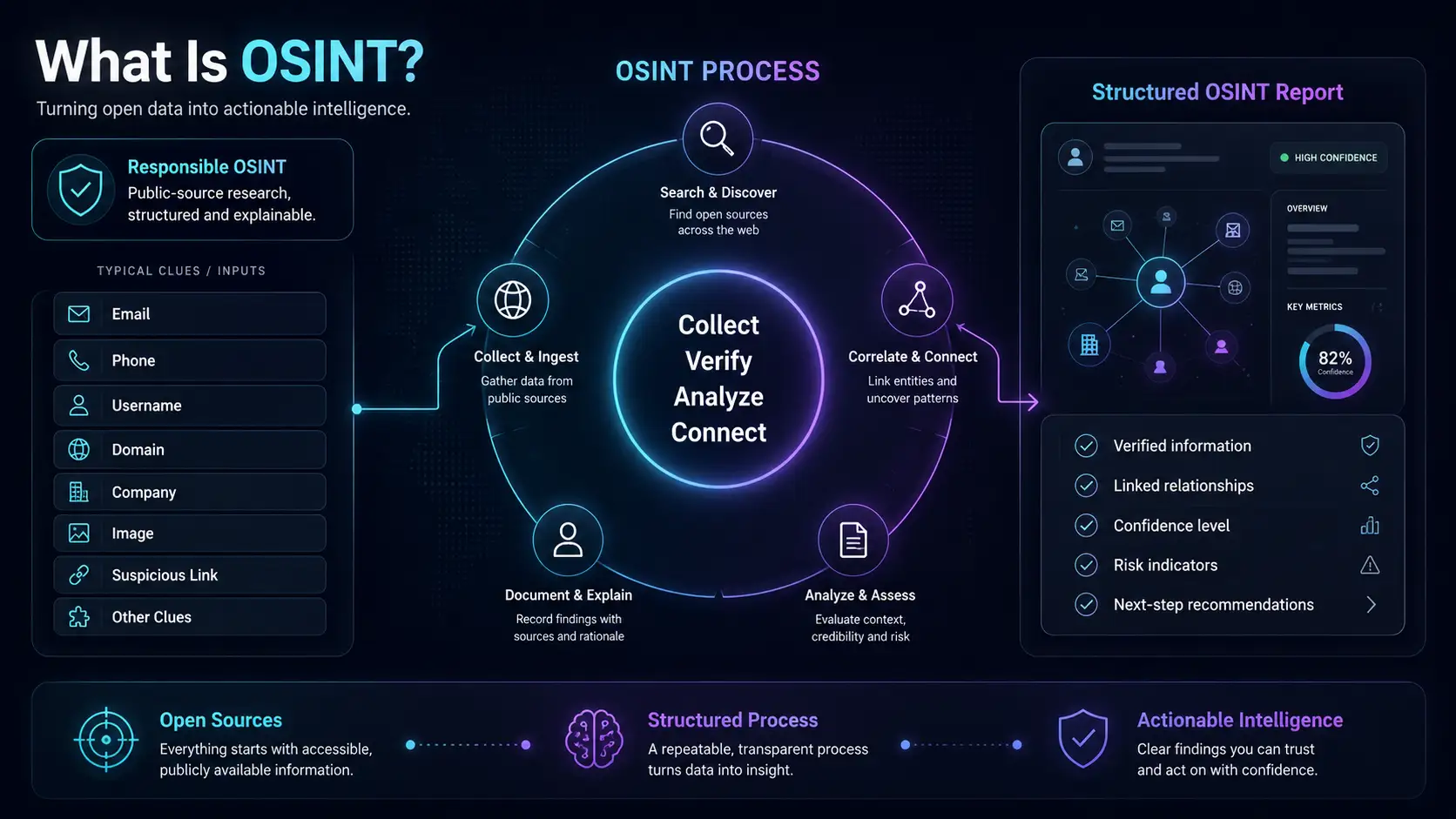
OSINT, or open source intelligence, is a structured way to find, verify, and analyze publicly available information in order to answer a real investigation question. OSINT is not just “searching the internet.” It is the process of turning raw clues — such as an email, phone number, username, domain, company name, image, or suspicious message — into context, confidence, and a practical next step.
A practical definition of OSINT
OSINT is the collection and analysis of publicly available information to answer a specific intelligence need. The key word is analysis. A search result, social profile, phone number, domain, or company page is not intelligence by itself. It becomes useful when it is checked, compared with other clues, placed in context, and connected to the original research question.
Public sources can include websites, news, social media profiles, company registries, domain records, archived pages, images, documents, public databases, forum posts, marketplace listings, search results, and visible metadata around digital activity. But professional OSINT is not about collecting everything. It is about selecting relevant clues, evaluating the source, and explaining what each finding proves — and what it does not prove.
That is why a strong OSINT investigation is closer to a disciplined research workflow than a quick search. The analyst or user must keep the investigation question in view, separate fact from assumption, watch for false matches, and explain results with confidence levels.
OSINT meaning: the letters stand for open source intelligence. Here, “open source” describes the information’s availability; it does not mean open-source software. SANS explains the distinction between public information and intelligence produced to answer a question.
OSINT framework: this can mean a research method or the independent OSINT Framework directory. A directory helps you find tools; a method tells you how to choose sources, verify findings and report uncertainty. See the OSINT tools comparison for their different jobs.
How does OSINT work?
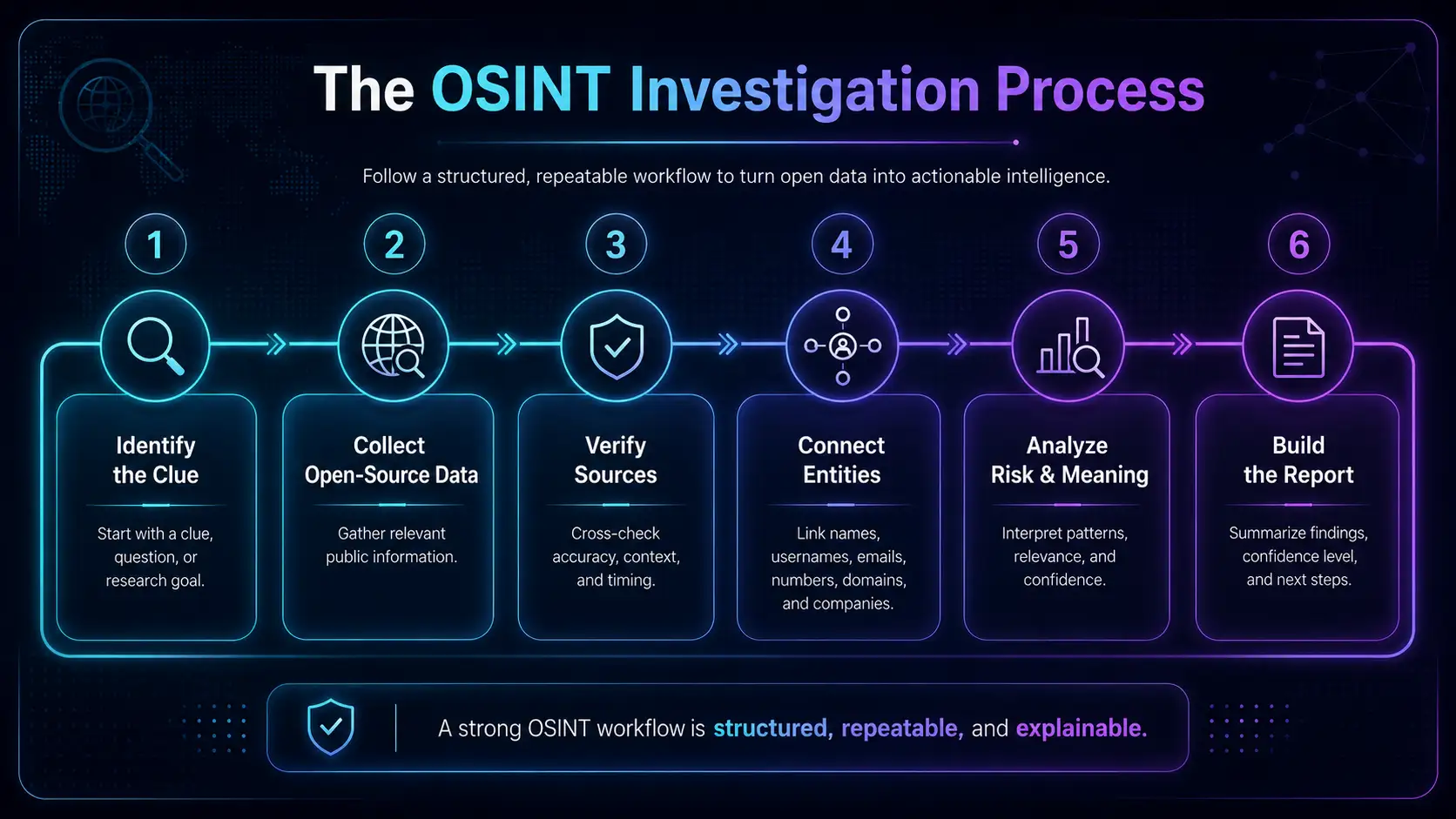
OSINT begins with a raw clue and moves toward a more reliable picture. The clue may be a phone number, email address, username, name, company, domain, image, payment receipt, suspicious message, or even a phrase from an online listing. The work is to build context around that clue without rushing to conclusions.
Define the investigation question
Instead of asking “find everything,” ask a precise question: “Is this website connected to a real company?” or “Does this phone number match the claim?” Better questions produce better reports.
List the available clues
Record the phone number, email, username, domain, city, company name, links, message text, and any relevant context. In OSINT, one spelling variant or missing symbol can change the path.
Search public sources
Use search engines, public pages, social media, archives, registries, OSINT search tools, and topic-specific sources. Do not rely on the first result.
Verify and compare
Check whether independent sources support the same conclusion. Is the data current? Could two people share the same name? Does a username actually belong to the same person or company?
Connect the clues
An email may connect to a username, domain, old profile, payment page, or company record. The value of OSINT is often in understanding these relationships.
Report with confidence levels
A strong OSINT report separates confirmed, likely, possible, weak, conflicting, and needs-review findings. It also explains what should be checked next.
What do common OSINT sources reveal?
The right source depends on the investigation question. A scam review may require domain analysis, payment-page context and site history. A digital identity investigation may begin with a username or email. A company check may require domains, public contact details, business signals and credibility indicators.
Search engines and archives
Useful for old pages, cached content, exact phrases, files, public mentions and historical context.
Social media and profiles
Useful for usernames, aliases, public links, visible activity patterns, profile images and related clues.
Domains and websites
Useful for business claims, landing pages, redirects, contact details, risk indicators and suspicious patterns.
Public and business records
Useful for company names, registration claims, addresses, public officers, business context and credibility checks.
Images and documents
Useful for visible details, screenshots, text inside images, logos, inconsistencies and contextual clues.
News and public reports
Useful for background, reported risk, similar cases, public warnings and social or business context.
A structured workflow for OSINT research
OSINT improves when you stop searching randomly and start following a repeatable process. The goal is not to make the investigation more complicated. The goal is to make the path clear, reviewable and explainable.
The OSINT Jet Intelligence Engine is built around this path: raw clue → structured investigation → risk analysis → report → reviewed follow-up options.
What do confidence levels mean in OSINT?
One major difference between professional OSINT and casual searching is that a good report does not create false certainty. It explains which findings are confirmed, which are likely, and which still need review.
Several independent sources align, the context is current, and the relationship between clues is explainable. Example: a domain, official email and public company page support the same entity.
The clues are consistent, but independent support is still limited. Example: the same username appears across platforms, but identity ownership is not fully established.
Only one weak signal exists, or the risk of a false match is high. This type of finding should not be used as the basis for a firm decision.
Real-world examples of OSINT use
OSINT becomes valuable when it supports a real decision. The following scenarios are illustrative teaching examples, not anonymized customer cases.
Checking a possible scam before payment
A user has a payment link, phone number and store name. An OSINT investigation reviews domain history, site context, message text, contact details and repeated risk signals.
Verifying a company or business claim
A company claims experience, offices and major clients. Company OSINT checks the domain, public contact details, business signals and whether claims align with public evidence.
Building a digital identity picture
An investigation starts from an email or username. The workflow reviews aliases, related domains, public profiles, visible relationships and inconsistencies with confidence levels.
Worked example: three pages, one unsupported claim
Fictional exercise: a seller using example.org claims to be an established company. These invented records teach verification; they are not findings about that domain or an OSINT Jet customer.
- Record A — seller’s About page: says “operating since 2015.” This proves the claim was published, not that the business existed in 2015.
- Record B — directory listing: repeats the same sentence and cites the seller. It is a second URL, but not independent confirmation.
- Record C — public registry: lists a similarly named company, but supplies no matching domain or registration identifier. Name similarity is a lead, not a verified link.
Report: “The seller’s trading-history claim remains unverified. Two pages repeat one source; the registry entry has not been linked to the website. Next, check the claimed registration identifier against the relevant official record and seek a direct domain-to-company link.”
For each record, save its URL, retrieval time, publication date if available, the relevant extract, what it supports and what remains uncertain. Do not convert “unverified” into “fraudulent.” Practice the method in the OSINT training exercises.
Common OSINT mistakes that damage the result
Most OSINT mistakes do not come from a lack of tools. They come from rushing the conclusion, failing to document the path, or mixing assumptions with findings.
Trusting the first search result
The first result is not always the most accurate result. Source, date, context and consistency with other clues matter.
Treating similar names as the same person
A shared name, city or image is not enough. You need multiple independent signals pointing to the same conclusion.
Ignoring stale data
A phone number, domain or profile may no longer belong to the same person or company. Timing matters.
Reporting without confidence levels
If a report does not separate confirmed, likely and weak findings, the reader cannot make a good decision.
Using tools without analysis
Tools produce clues. Verification, context and false-match review are still required.
Starting without a research question
Without a question, OSINT becomes unfocused link collection instead of useful intelligence.
OSINT tools matter, but workflow matters more
Tools can speed up collection, but they do not replace judgment, source awareness and structured analysis. A tool may show a possible match, but it cannot prove by itself that the match belongs to the same person, company or case. Strong OSINT combines tools, methodology and clear reporting.
Quick checklist before starting any OSINT investigation
Before you open tools or run a full report, this checklist helps make your input cleaner and your investigation more reliable.
Manual OSINT vs the OSINT Jet Intelligence Engine
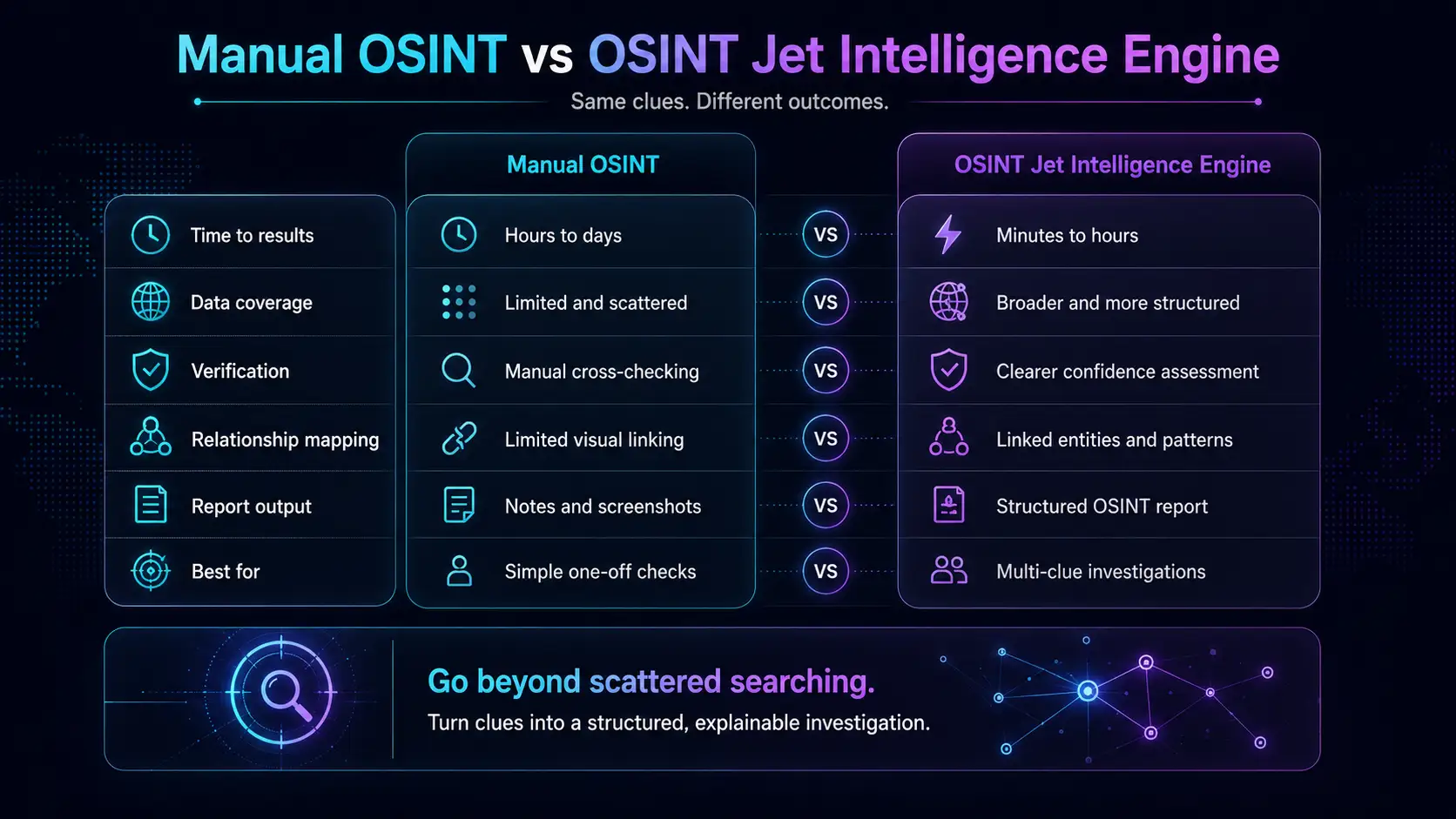
Manual OSINT is valuable for learning and simple checks. But when clues multiply, the case carries financial or reputational risk, or the output needs to support a decision, an intelligence engine can make the path faster, clearer and more structured.
Responsible OSINT: where are the boundaries?
Responsible OSINT means careful, proportionate use of publicly available information. Healthy OSINT does not require unauthorized access, deception, impersonation, hacking, misuse of private accounts, harassment, threats, or unnecessary exposure of personal information. The fact that data is visible somewhere does not mean every use of it is appropriate.
Stay within public sources
Use public pages, visible data, lawful tools and legitimate research paths. Bypassing access controls or extracting private data is not responsible OSINT.
Avoid unnecessary harm
Review and report only information relevant to the question. Unnecessary detail can create harm without adding analytical value.
State confidence levels
Separate confirmed findings, likely connections, weak clues and open questions. Responsible reports do not hide uncertainty.
Explain the reasoning path
A strong report does not just state a conclusion. It explains where findings came from, why they matter and what could change the conclusion.
When should you move from manual search to OSINT Jet?
Manual search is enough when the question is simple and you have time to review a few sources yourself. But when a case has multiple clues, visible risk, different languages or countries, connected domains and companies, or an output that needs to support a decision, the OSINT Jet Intelligence Engine can help turn the case into a structured report.
When clues multiply
A phone number connects to an email, username, domain, company or suspicious message, and a simple search no longer gives a clear picture.
When money or reputation is involved
Before payment, trust, collaboration, hiring, replying to a suspicious message, or sharing sensitive information, a structured review matters.
When the next step matters
A good report does not only list findings. It shows what should be checked next and how the investigation can continue.
A practical OSINT learning path for beginners
A common beginner mistake is to chase tools before learning the investigation method. A better path is to learn OSINT logic first, then advanced search, then clue types, and finally report writing.
1. Foundations
Understand what OSINT is, what public information means, and why verification is more important than searching.
2. Search skills
Practice precise search, multilingual terms, archives, source comparison and query design.
3. Clue types
Build separate workflows for phone, email, username, domain, company, image and fraud investigations.
4. Reporting
Turn findings into decision-ready reports with confidence, limitations, risk and next steps.
Common questions about OSINT
What does OSINT mean?
What is OSINT, and how is it different from a simple web search?
Is OSINT only Google searching?
What is OSINT used for?
Is OSINT legal?
What information should I provide for a better report?
What is the best starting point for OSINT beginners?
When should I use the OSINT Jet Intelligence Engine?
Explore this topic
Turn the definition into a small research exercise
Choose a question, select a source and record what the result actually supports. Compare the main tool roles, then use a report template to make the evidence and uncertainty easy to review.